
Wearables
For quite some time “Wearables” was the hottest new topic across the industry. Today, it’s not necessarily the separate topic that once was as wearables have been absorbed into the differing markets that have wearable needs. Today, wearable applications continue to grow at a rapid pace and products are being introduced across most every market - consumer products, medical, industrial and more.
FCT has supported wearable applications with flexible circuits and assemblies dating back to 2006 when we began to address a medical application involving an electronic “chest worn” patch that would monitor a patient’s heart. We designed the flex, built the prototypes and then supported the assembly to the complete product box build as the program went to production. Once this program went to production… the race was on as other wearable applications began to come to market at a rapid pace.
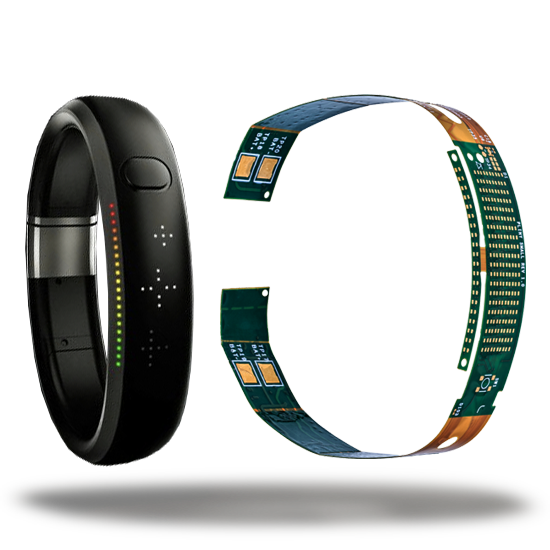
In 2012, we took on another exciting wearable project while working with a product design firm who was engaged with the leading athletic wear company on the globe. This program involved the first major activity tracker - a wrist worn band.
While working with other flex supplies, the product design firm could not get the flex circuit to work or perform as required for this demanding application. FCT was engaged and did a design review. We then came up with breakthroughs in the design that led to a flexible circuit that performed under extremely challenging conditions. That breakthrough led to the most successful product launch in the Wearable space at that time.
We supported this opportunity with design review, design changes and optimization, prototyping, and also were the sole source for production for this high-volume program.
FCT has addressed a significant number of challenging wearable applications across a variety of industries – from head to toe!
FCT’s superior expertise in design is what allows us to attain such breakthroughs in helping our customers to attain cost effective solutions that will perform within the challenging applications including those that are inherent in wearables.




Get A Quote
"*" indicates required fields
Any Questions?
Call 888-921-6167 (USA and Canada) or +1-763-545-3333 (International) and ask to speak to one of our Applications Engineers. Or Email us here.